
All that sugar is not too sweet
Green Chutney, Issue 01

We all may have experienced that moment on a hot May evening, sitting under the ceiling fan, almost cross with Nature for inventing the summer season while sipping Coca-Cola as if our lives depended on it. Most of us Indian kids may remember being greeted with jalebi or chikki by our Nanu-Nani upon their annual visits! Well, sugar has been such a vital reward for us in our daily life, bringing joy and togetherness. For irony’s sake, we even got lollipops from our dentist and Cadburys in school assemblies. In this newsletter, we aim to investigate the extent to which the food industry has manipulated emotional pleasure associated with sugar to make it sound like it is okay, when it really is not.
But first things first.
In this issue, when we say “sugar”, we refer to the white-polished-crystals in most of our kitchens, and almost all of the packaged foods in the world. This type of refined sugar has a whole array of hidden names: the saccharides, the saccharins, the oses, the ols, the syrups and some of whom go by encrypted names like C12H22O11 instead. Turn any edible product packaging around and play detective on the ‘ingredients’ or ‘label’ section, to see what we mean.
Another product family that has been so cleverly advertised are “artificial sweeteners”.
Were you watching Republic TV last year when the World Health Organisation broke the news that “artificial sweeteners have potential undesirable effects from long-term use… such as cardiovascular diseases…”? While my grandfather watched all the interviews that poured in from dieticians and doctors validating this claim, I couldn't help but wonder - how many millions of people had already consumed how many billions of granules of artificial sweeteners so far? This includes our own moms who think that by replacing sugar with “Sugar Free” or “Equal” in their chai, they are safe from putting on extra kilograms. Nonsense – in its purest form.
All the fluff about “sugar” giving us “energy” is strategic PR campaigning for sugar brands and sugar products. Truth is, highly processed sugar (called sucrose) is waste for the body – “empty nutrition” as Dr. Vijaya Venkat puts it. Dr. Venkat advocated the ill-effects of sugar over three decades ago by breaking down fundamental biochemistry for us… “one of the main functions of our body is to convert ALL the food we eat into glucose. This happens through a series of biochemical actions with the help of enzymes.The glucose thus produced is synthesised according to the body’s requirement… which is the “energy” the body really needs and can use.. Whereas sucrose, i.e. C12H2O11 which is commonly termed as commercial sugar, contains atoms of carbon, hydrogen and oxygen… it has no enzymes or trace elements, no fibre, no protein, no fat… Nothing to offer.”
Processed sugars do not get metabolised in our bodies. They are moved around hopelessly in our bloodstream before being stored in the liver. Deposits then settle in fat-prone areas like our arms, thighs and bellies (all that extra weight we fret on).
Sugar consumption behaviour has been linked to that of drug addiction. French researchers agreed that the “rewards experienced by the brain after consuming sugar were even more incentivising than the use of cocaine”. Additionally, countless scientific associations between ultra-processed food and multiple adverse health outcomes are already out there. What is funny to us, and should be to you as well, is how creatively sugar is still marketed every single day across the food spectrum.
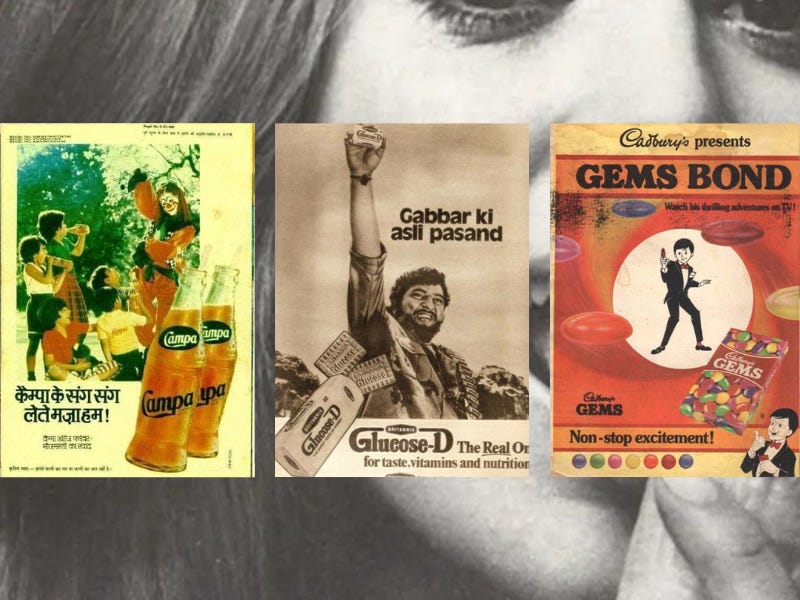
Print ads for sugar products since the 1950’s (India). Source: https://www.scoopwhoop.com/entertainment/bollywood-ads-vintage/
It is rather concerning, how sugar has become an indispensable and acceptable part of the human diet. An alarming populace of the United States suffers from obesity and diabetes, primarily because they have been used to, since early on in their lives, casually grabbing a piece of cake or a can of soda on a drive back home.
You must have heard from one of the youtube-taught family doctors that it is cholesterol and triglycerides that are to blame for heart disease. However, John Yudkin, a leading nutritionist from the UK grabbed the attention of millions when he claimed that it is not fatty foods alone, after all, but sugar that is the main cause of coronary heart disease.
Companies have been playing with the health of nations to swim deeper in the pools of profits. However, since early 1950’s, scientists have been raising concern. Read about ‘The Sugar Association’ (TSA, USA) and you will get the jitters. In 1976, TSA launched a mega successful PR Campaign that turned around the entire conversation about sugar and its ill effects on the human body by convincing American citizens that it wasn’t just safe, but “healthy” to consume. They went to unbelievable lengths to fund opposing research to claim that sugar was a harmless product under attack by “opportunists dedicated to exploiting the consuming public.”
But do all these bigshot corporations operate the same way? To find out, we spoke to Ria who works in a multinational ad agency in New York. As a Client Manager, her daily role involves managing project expectations and devising strategies to upsell services to her clients in the “FMCG, telecommunications, financial and medical industries”.
We asked her to what extent she “evaluates the integrity of the product or service her team is creating content for?”
“This is a tricky question as I do not always choose what product or services I produce content for. I have worked with certain brands in the past to vastly influence customer choices irrespective of the integrity of the product. There has only been one time where I did not work on a project because I did not resonate with the brand and its products, but this is not a usual case. It can be tough as agencies also try to greenwash a lot of work that they do for their clients in order to appear otherwise.”
“How do teams in ad/marketing agencies study and impact consumer behaviour?”
“Using emotions to alter people's behaviour is one of our best strategies to influence them. Take the example of Snapchat or Instagram stories, they thrive on human emotions like anxiety…
This applies to the food industry as well. There are new milkshake shops that have recently blown up. New cookies, donuts, ice creams going viral. Starbucks’ special drinks popularise very easily with limited-time offers, high discounts, newest trends or just simply glorified FOMO marketing if someone hasn’t visited the coffee-shop yet even though all of its products are heavy on sugar content… I have worked on many brands that hone on special emotions like anxiety, fear, FOMO, insecurities, etc. to sway people’s behaviour. Habit forming products have become a new normal for users/consumers to get addicted and keep coming back to… To make consumers consume things that they usually wouldn’t consume much of, is one of our advertising goals.”
This interview made us think about the role of advertising and marketing in our daily decision-making. As educated individuals reading this newsletter, we still have a choice to deflect noise. What about the vulnerable communities who are swayed to believe everything?
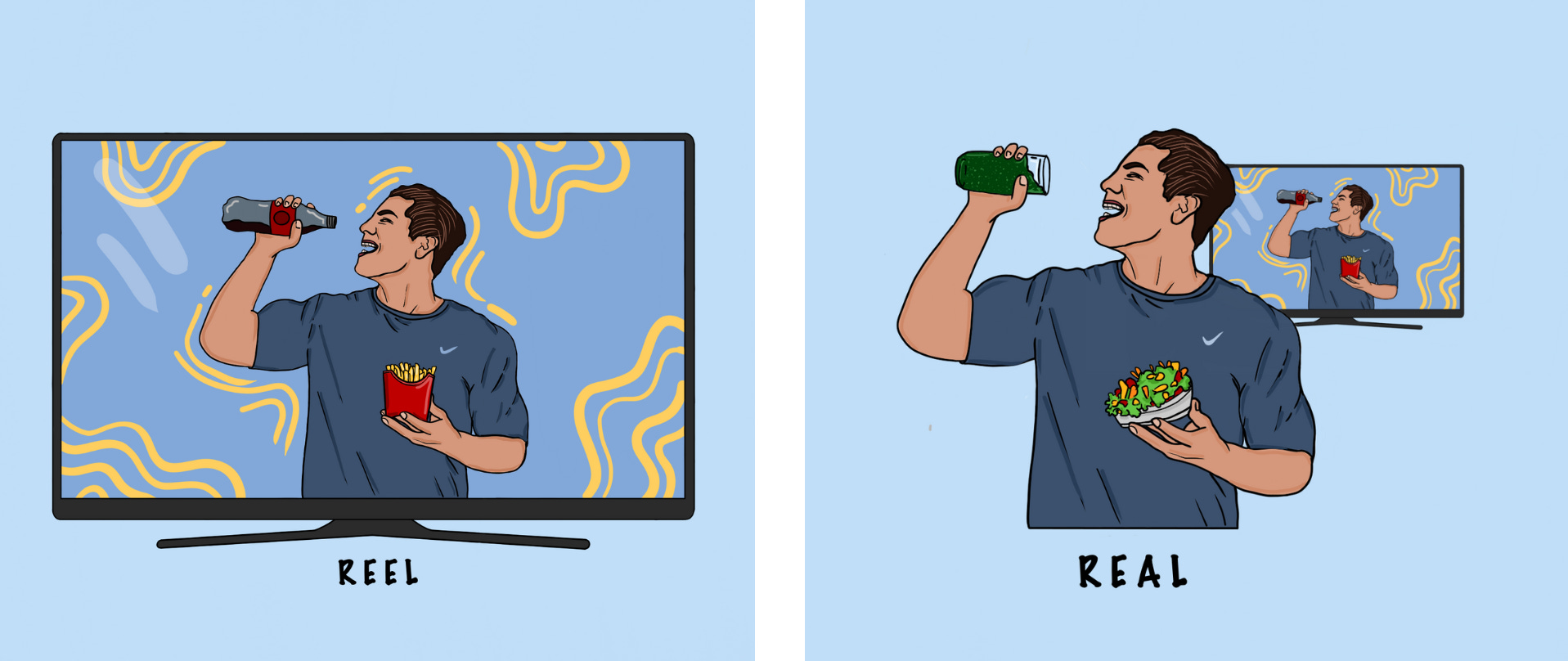
Irony of celebrities being the face of junk food brands. Artwork by Aabha Deshmukh.
Does India have any policies in place against sugar marketing? (a,b,c)
Interestingly, India is the world’s second-largest producer of sugar. Within the country, the sugar industry is the second-largest agro-industry after textiles. Uttar Pradesh alone has 155 sugar mills, notes journalist Monika Mondal. The rest of the nation’s sugar mills and distilleries are among India’s 17 highest-polluting industries, discharging water into the Ganga River.
In 2020, The Food Safety and Standards Authority of India (FSSAI) banned the sale of high fat, salt, and sugar-based (HFSS) foods and beverages to schoolchildren inside the premises and within 50 metres of the school gates. Companies cannot market logos, brand names, or poster ads inside school premises or on children’s textbooks. However, there is no regulation mandating junk food labelling. Read Advocate Arvind Sehdev’s summary of this regulation from a legal perspective.
Legal Provisions exist for the advertisement or promotion of junk food using false representation of its composition, quality, etc. or falsely representing characteristic uses or benefits of such food or beverages.
Recently, in India, the Guidelines for Prevention of Misleading Advertisements 2022 were released by the CCPA (Central Consumer Protection Authority), covering all types of media and advertisements. Although the guidelines seek to regulate ‘junk food’ advertisements, there is a certain amount of ambiguity around what constitutes ‘junk food’ or ‘exclusively for children’, which may not include newer types of media. These guidelines also do not have specific criteria for ‘brand extension’ and ‘indirect advertisement.’
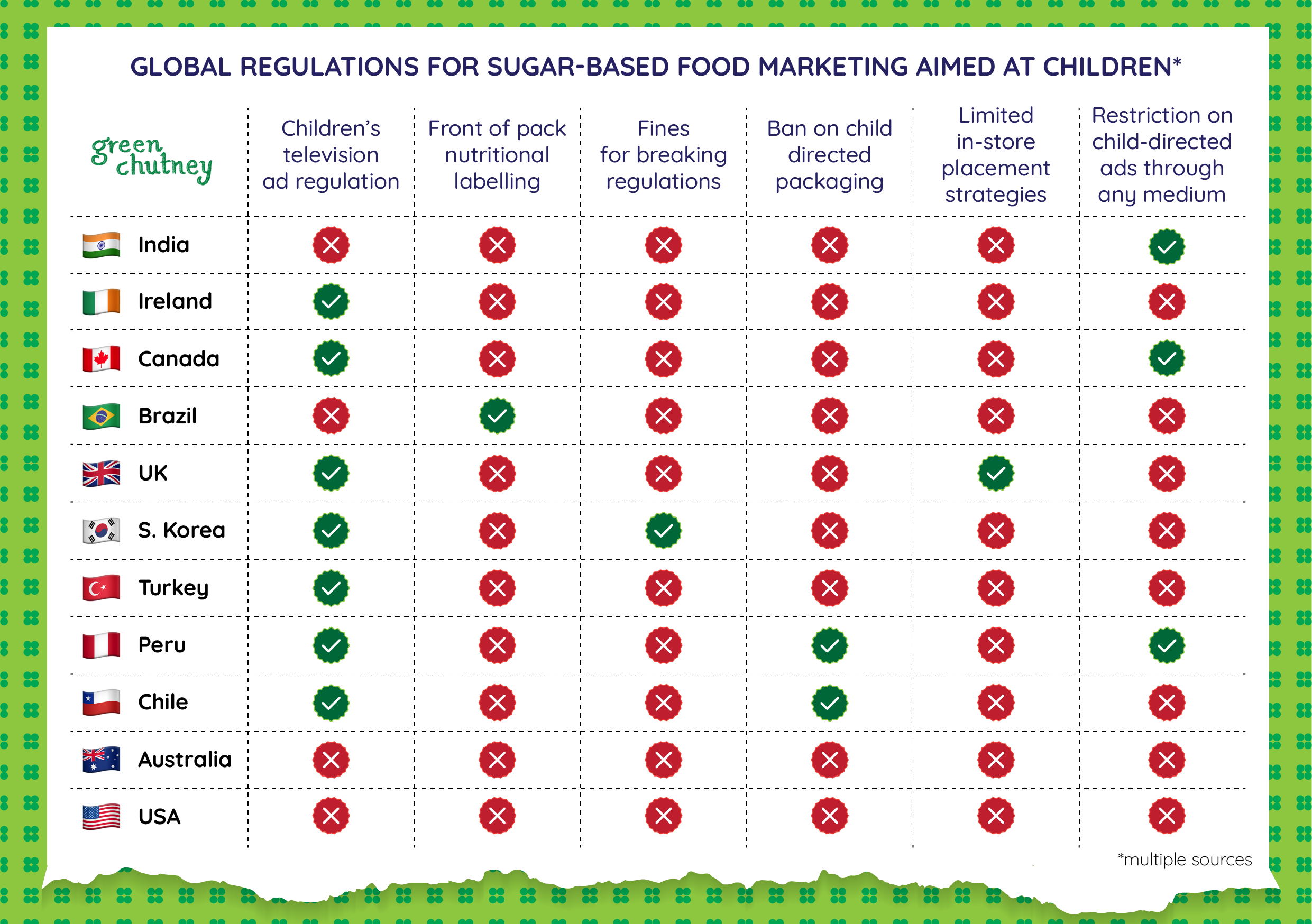
Table 1: Global regulations for HFSS food marketing aimed at children. Multiple sources.
Jo dikhta hai woh bikta hai. Good marketing is all there is.
What we are saying is…
Processed sugar is present in almost all everyday items like toothpaste, biscuits, sodas, chocolates, cakes, muffins, la di da. Subliminal messaging through bright colours on packets or smiling faces claiming “instant energy” are just some tactics to lure you. Mindless consumption is really a silent monster (better to scare your kids with this rather than bhoot baba. Bhoot baba is friendlier).
Look out for small, locally grown brands promoting alternatives in your city. Some of our favourites in Mumbai are The Village Shop, Healthy Mess and Sweegan.
Explore the world of FRUITS and DRY FRUITS! The healthiest form of sweet we can get.
Home chefs have been active since after Covid-19 and more agile to personalised requests for cakes, cookies and more. Ask your neighbourhood aunty!
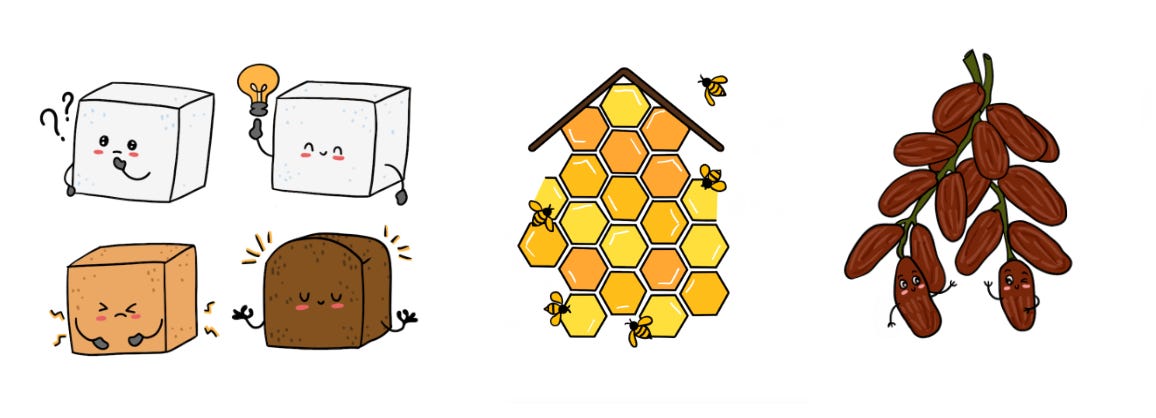
As for your own kitchens, believe us, jaggery, honey and dates will surprise you if you let them. Your chai will taste as good as it does with gur as it did with chini (add the gur to the cup before pouring hot chai inside).
And darlings, please indulge when you want to - remember us and do it mindfully!
With love,
Team Green Chutney
Further resources
Bibliography
Dr. Vijaya Venkat, The Health Awareness Centre (THAC)
John Yudkin
Smith, John D., Doe, Alice B., & Johnson, Chris. (2008). Title of the article. Journal of Scientific Research, 10(3), 245-260. https://www.ncbi.nlm.nih.gov/pmc/articles/PMC2235907/
Elizabeth, L., Machado, P., Zinöcker, M., Baker, P., & Lawrence, M. (2020). Ultra-Processed Foods and Health Outcomes: A Narrative Review. Nutrients, 12(7), 1955. https://doi.org/10.3390/nu12071955
Healthline. (n.d.). Is Sugar Addictive? Experts Share Their Thoughts. Healthline. https://www.healthline.com/health/food-nutrition/experts-is-sugar-addictive-drug
Vartanian, L. R., Schwartz, M. B., & Brownell, K. D. (2007). The Potential Role of Sugar-Sweetened Beverages in Weight Gain. The Journal of the American Medical Association, 298(22), 2777–2779. https://doi.org/10.1001/jama.298.22.2777
Keshavarzi Arshadi, A., et al. (2020). A New Approach to the 5-Year Survival Prediction of Breast Cancer Patients Using Ensemble Learning. Frontiers in Artificial Intelligence, 3, 34. https://doi.org/10.3389/frai.2020.00034
Quebec Consumer Protection Office. (n.d.). Guide to Illegal Advertising Practices Targeting Children Under 13. https://cdn.opc.gouv.qc.ca/media/documents/consommateur/sujet/publicite-pratique-illegale/EN_Guide_publicite_moins_de_13_ans_vf.pdf
National Food Strategy. (n.d.). Home. Retrieved from. https://www.nationalfoodstrategy.org
UNICEF Mongolia. (n.d.). Marketing of unhealthy foods and non-alcoholic beverages to children [PDF document]. Retrieved from https://www.unicef.org/mongolia/media/5591/file/Marketing%20of%20unhealthy%20foods%20and%20non-alcoholic%20beverages%20to%20children.pdf
Brownbill, A. L., Miller, C. L., & Braunack‐Mayer, A. J. (2018). The marketing of sugar‐sweetened beverages to young people on Facebook. Journal of Global Health Reports, 2(4), 354-360. https://doi.org/S1326020023051956
Magnus, A., Haby, M. M., Carter, R., & Swinburn, B. (2009). The cost-effectiveness of removing television advertising of high-fat and/or high-sugar food and beverages to Australian children. International Journal of Obesity, 33, 1094–1102. https://doi.org/10.1038/ijo.2009.156
Dickert, N. W., & Eyal, N. (2020). The COVID-19 Pandemic and Human Subject Research: Protecting Research Participants and Promoting Ethical Research Conduct. Journal of Medical Ethics, 46(10), 639–640. https://www.ncbi.nlm.nih.gov/pmc/articles/PMC7399967/
Begley, S. (2012, October 1). Sweet Little Lies: How the Sugar Industry’s Clever Campaign to Polarize Science Kept Americans in the Dark About the Risks of Its Product. Mother Jones. https://www.motherjones.com/environment/2012/10/sugar-industry-lies-campaign/
Rajeev, M. V. R., Jha, S., & Kumar, P. (2020). Drones for honey bee health assessment: a review. Apidologie, 51(1), 3-21. https://doi.org/10.1007/s13592-020-00745-6
Saltzman, N. A., Deveney, T., & Fallows, J. (2018). The effect of rates of weight loss on long-term weight regain in adults with overweight and obesity. International Journal of Obesity, 42(1), 5-13. https://doi.org/10.1038/ijo.2009.156
Khan, M. N., Al Mamun, A., Haque, M. R., Ahmed, H. U., & Islam, S. M. (2023). Prevalence and predictors of mental distress among people affected by the COVID-19 pandemic in Bangladesh: a nationwide cross-sectional study. BMC Public Health, 23(1), 333. https://doi.org/10.1186/s12889-023-16821-2
Jia, W., & Wang, J. (2014). Big Data Technology and its Applications. Journal of Computer Science and Technology, 29(5), 759-789. https://doi.org/10.1007/BF02943746
Monika Mondal. (2021, July 8). Investigation: Water crisis in the sugar bowl of India. The Third Pole. https://www.thethirdpole.net/en/pollution/investigation-water-crisis-sugar-india/
Johnston, M. (2015, October 16). The 5 Countries That Produce the Most Sugar. Investopedia. https://www.investopedia.com/articles/investing/101615/5-countries-produce-most-sugar.asp
Cheena Kapoor. (2023, February 9). India's push to use sugar for ethanol may create problems. The Third Pole. https://www.thethirdpole.net/en/energy/indias-push-to-use-sugar-for-ethanol-may-create-problems/
Dantas, F. P., Marques, S., Rubim, J. C., & Wolf Maciel, M. R. (2011). A review of xylitol production from lignocellulosic materials. Sugar Tech, 13(4), 336-343. https://doi.org/10.1007/s12355-011-0115-z
Al-luqman, I. M. A. (2011). Modern biotechnology and its applications in pharmaceuticals and medicine: a review paper. Journal of Pharmaceutical Health Services Research, 2(2), 101-105. https://doi.org/10.1057/jphp.2011.46
Salem State University. May 2022. Silly Rabbit, Manipulative marketing Tactics Are For Kids! – Exploring The Effectiveness Of Ethical Children’s Cereal Packaging. Salem State University Digital Repository. https://digitalrepository.salemstate.edu/handle/20.500.13013/2659
GBD 2017 Diet Collaborators. (2015). Health effects of dietary risks in 195 countries, 1990–2017: a systematic analysis for the Global Burden of Disease Study 2017. BMJ, 350, h795. https://doi.org/10.1136/bmj.h795
GBD 2017 Diet Collaborators. (2015). Health effects of dietary risks in 195 countries, 1990–2017: a systematic analysis for the Global Burden of Disease Study 2017. BMJ. https://www.bmj.com/content/350/bmj.h795.full
Schulz, P. J., & Andorno, R. (2020). Nudging and manipulation: Ethical considerations. Theoretical Medicine and Bioethics, 41(1), 7-25. https://doi.org/10.1007/s12152-020-09442-8
Moll, J., Ramos, R. T., & Ribeiro, O. (2022). The ethics of deep brain stimulation: A scoping review. Journal of Empirical Research on Human Research Ethics. Advance online publication. https://doi.org/10.1177/15245004221126580
Danciu, V. (2014). Manipulative marketing: Persuasion and manipulation of the consumer through advertising. Theoretical and Applied Economics, 21(2), 19-34. Retrieved from https://citeseerx.ist.psu.edu/document?repid=rep1&type=pdf&doi=5cbe76dbb0b4707d32c8439ce6d4c184a591251f
St-Onge, M. P., Mikic, A., & Pietrolungo, C. E. (2020). Effects of diet on sleep: A narrative review. Nutrients, 12(7), 1955. https://doi.org/10.3390/nu12071955
Kickbusch, I. (2016). Health promotion: The importance of environment. Health Promotion International, 31(4), 954-963. https://doi.org/10.1093/heapro/daw039
Food Safety and Standards Authority of India (FSSAI). (2020, September 9). FSSAI News: Healthy Financial [PDF document]. Retrieved from https://fssai.gov.in/upload/media/FSSAI_News_Healthy_Financial_09_09_2020.pdf
Sehdev, A. (n.d.). Junk Food Without Laws: Fast India [LinkedIn article]. LinkedIn. https://www.linkedin.com/pulse/junk-food-without-laws-fast-india-arvind-sehdev/
Taubes, G., & Kearns Couzens, C. (2012, October). Sweet little lies: How the sugar industry is trying to get you hooked. Mother Jones. https://www.motherjones.com/environment/2012/10/sugar-industry-lies-campaign/